- Welcome to Make a Marimba.

Recent posts
#61
Instrument BARS & tuning / Re: Glockenspiel pitch change
Last post by MStaples - January 16, 2009, 09:29:09 AMThanks so much for the information, Jim! I thought I could adjust the pitch with a little grinding, but I had concern that there was more to the big picture than I was aware of.
MS
MS
#62
Instrument BARS & tuning / Re: Glockenspiel pitch change
Last post by Jim McCarthy - January 15, 2009, 05:02:00 PMIn terms of the job Michael, you are pretty much on the money! It shouldn't be too tricky and it's just a matter of grinding a tiny bit in the middle of the bar as you say. Even if the instrument has overtones tuned, you can't put them out by an amount that will matter if you are only dropping the fundamental by a few cents.
before you proceed however, I would recommend doing a little online research into what tunings are actually desirable for glocks. It also would be worth using your tuner to get accurate readings on all the bars as they currently stand.
Many people actually prefer to have higher pitch instruments like glocks a little sharp to fit in with stretch tuning principles - google "stretch tuning". Also just because the sound of the glock is supposed to be bright, having it a little sharp can help its sound.
I'll be interested to hear what you find out!
All the best
Jim
#63
Instrument BARS & tuning / Glockenspiel pitch change
Last post by MStaples - January 15, 2009, 07:16:53 AMI have a 2 1/2 octave student glock with steel keys that are tuned to A=442. I'd like to change its pitch to A=440 since everyone else in the local contra dance pickup band I'd like to join (read: annoy) tunes to A=440. From all I've read in this forum and www.makeamarimba.com it seems clear to me that this would be an easy mod by simply grinding (very carefully) beneath the midpoint of the bars (the fundamental note's anti-nodal area) to lower the pitch. Using an online calculator, I believe that I need to lower the pitch approximately 7.85 cents. Before I ruin a perfectly good set of bells, I thought I would run this idea by the group for confirmation of my plan or any other ideas about my goal.
MS
MS
#64
Instrument BARS & tuning / Re: Glockenspiel bar dampening
Last post by Jim McCarthy - January 13, 2009, 06:16:04 AMHi Michael
You could try cutting a thin strip of thin felt - say 1cm or 1/4 inch for each row of bars. Lay it just outside the row of pegs on the ends of the bars. Some of the classroom style metalophones have a felt topped dampening bar placed in a similar position to a vibraphone's. They are simply operated by a small hand lever - in the case of a chromatic glock, you would probably drill through the end timber to pass a handle axis through.
Anyone else? - I'd be interested in the ideas and experiences of others here!
Jim
#65
Instrument BARS & tuning / Glockenspiel bar dampening
Last post by MStaples - January 12, 2009, 01:52:36 PMI'd like to hear other's experience with Glock bar dampening. My goal is to dampen the sustain, but maintain a good sounding bar to avoid dissonance of two or more bars ringing together during a played passage. Using one hand to dampen bars doesn't seem like a good solution except in a few cases. What has worked for me is using foam strips with adhesive backing (designed for weatherproofing windows and doors) 1/4" - 3/8" in width, 1/4" tall, length cut as needed. I did not have good results sticking small pieces of it to the ends of the bars, but acceptable results were had by placing bits beside the pins (in the nodal area) of the bar. Not a very tidy solution, but it works. Anyone else have experience with this?
MS
MS
#66
General Discussion / Re: Cane or rattan source for ...
Last post by Jim McCarthy - January 09, 2009, 07:04:33 PMHi Michael.
I can't help out on this one with a specific place unfortunately, but I do remember years ago I managed to source some decent cane handles from a small shop/factory which made cane furniture. If there is such a shop in your area it might be worth giving them a call - even if they don't have the right stuff, they will probably be able to tell you where their supply comes from.
Jim
#67
General Discussion / Cane or rattan source for mall...
Last post by MStaples - January 09, 2009, 12:45:39 PMI'd like to try cane or rattan for the marimba mallets I'm making, but have not been able to find a source. Anyone?
MS
MS
#68
Instrument BARS & tuning / Re: Seiko SAT800 tuner review
Last post by Jim McCarthy - January 06, 2009, 03:07:51 PMAn excellent review with some very worthwhile and accurate observations - Thank you Michael!
SO true about the ear and experience...
Jim
SO true about the ear and experience...
Jim
#69
Instrument BARS & tuning / Seiko SAT800 tuner review
Last post by MStaples - January 06, 2009, 08:49:37 AMReview of the Seiko SAT800 chromatic tuner – Michael S
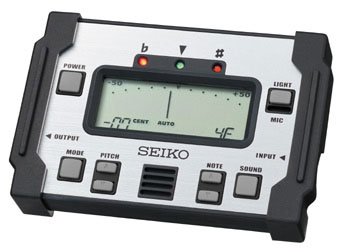
When I needed a device to tune marimba bars that I was making, I wanted one that was reasonably priced, chromatic and displayed the octave of the note being measured. The octave display appealed to me since the fundamental and second overtone of a marimba bar (as they are currently tuned) are over three octaves apart. If you need information on the process of creating and tuning marimba bars, I refer you to www.makeamarimba.com.
There were very few choices in affordable tuners that met the criteria I mentioned above. The one I selected was the Seiko SAT800. The Seiko is a hand held tuner that is digital, chromatic, backlit, has a built-in tone generator and a good price ($32.95 USD).
Basic features: The SAT800 has a brushed aluminum face, plastic body, built-in microphone, LCD display and soft plastic control buttons on the face. It has rubber bumpers for shock protection on both ends of the case. It takes 2 AAA batteries and has a slit in the back in which you can insert a card to serve as a stand. It tests in the range of 0A – 8C, has a stated accuracy of +/- 1 cent and can generate reference tones in the range of 4C – 4B. The unit's reference can be adjusted from (US) standard A=440 to between A=410 and A=450.
Power and backlight: The backlight is bright when turned on, dims in 15 seconds of no activity and turns off after 3 minutes without input of some kind. The unit will turn itself off after 10 minutes without input and saves its current settings (not backlight settings) for the next time it is used.
Display: It has an LCD representation of a meter needle that shows the deviation from the stated note. Above the meter display, it has two red and one green LED. Red LEDs represents that the note is sharp or flat and the green LED lights when the perceived tone is within +/- 3 cents of the displayed or manually chosen note. The note and octave are displayed in the lower right corner and the deviation in cents from the stated note in the lower left corner.
Modes: Auto: Auto-senses tones being played and displays the results. Manual: allows the user to choose a target note and test the note being played against it.
Features probably not useful to the marimba maker:
It can be used in-line between an instrument and an amplifier and will always allow the signal through whether it is on or off. The manual mentions an external contact mike that is available (Seiko STM20).
Dire predictions for marimba makers:
The manual recommends that the SAT800 is "not to be used in a dusty place" and "Musical instruments that generate harmonic overtones or short sustain tones may not be tuned accurately".
Impressions:
The SAT800's controls are well labeled, easy to understand and operate. The display is nicely laid out and useful. The tone generator works as stated and is useful, but the timbre is quite buzzy. The backlight is a great feature for an LCD display and intelligently implemented. The microphone is not as sensitive it should be and the marimba bar needs to be held very close to the microphone for accurate measurement.
Conclusion:
If you carefully select the place in which you hold the bar, where you strike it and what you strike it with to accentuate the mode (fundamental, first or second overtone) you are trying to produce, then the SAT800 will accurately test and display the fundamental, first overtone and their respective octave ranges. I believe from using the unit, that it has the potential to help with tuning the second overtone, but this reviewer is not experienced enough in this regard to comment.
The real benefit of the SAT800 to me was the education in how complex the tones generated by a marimba bar are and how factors like where the bars is held, where it is struck and the type of device used to strike with can influence the tone produced. It showed me better how a marimba bar responds than a unit that does not display the octave could.
The cost of the additional features (backlight and octave display) were well worth the extra expense of a comparable unit without these features.
Although I for one, need an external measuring device to produce good marimba bars. I don't think any device can substitute for trusting your ear (a fantastically sophisticated measuring device itself) to better understand the process nor substitute for the experience of carving (and ruining) a few marimba bars.
Michael S
#70
General Discussion / MOVED: "Seeing" the notes
Last post by Jim McCarthy - January 03, 2009, 10:09:12 PMThis topic has been moved to Playing, Performance, Practise.
Just organizing here...
http://www.makeamarimba.com/forum/index.php?topic=4.0
Just organizing here...
http://www.makeamarimba.com/forum/index.php?topic=4.0